INTRODUCTION
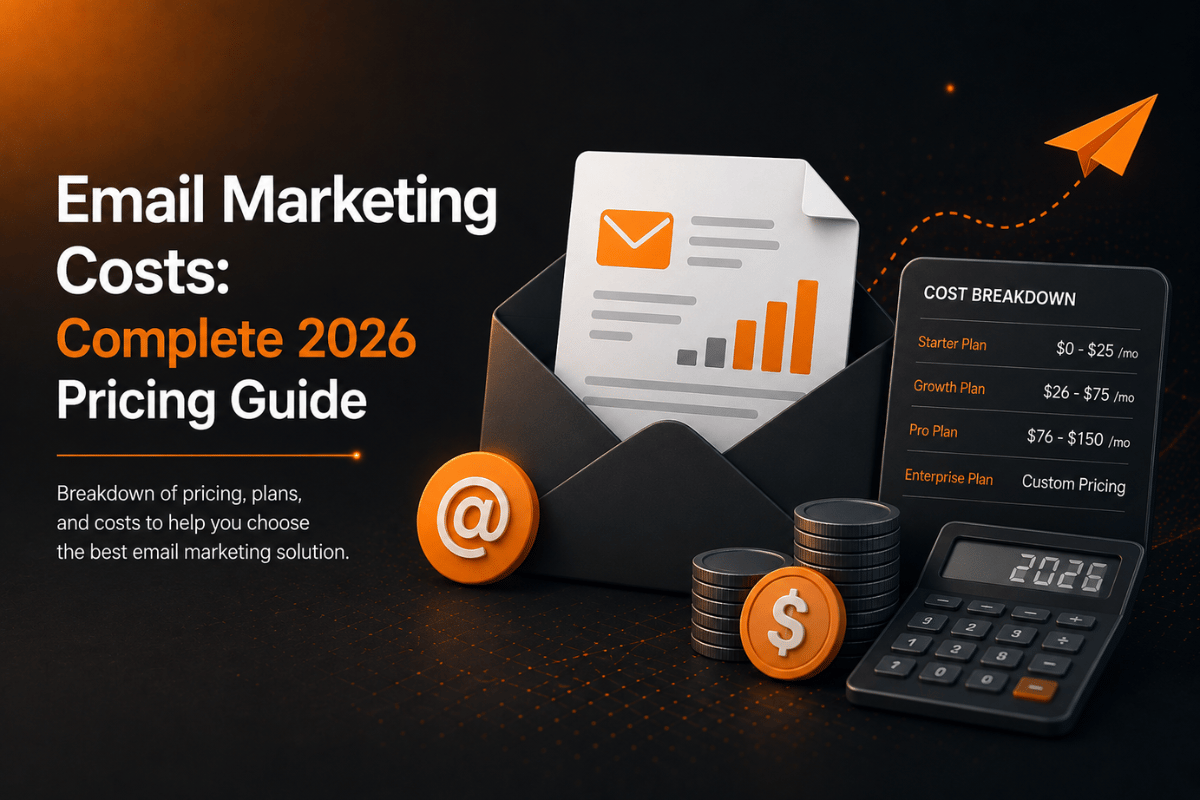
If you are planning to use email to generate leads, nurture customers, promote products, or increase repeat purchases, one question is almost impossible to avoid: How much does email marketing cost?
The answer depends on much more than the email platform you choose.
Your total Email Marketing Cost can include software subscriptions, subscriber volume, email design, copywriting, campaign management, automation, analytics, list management, integrations, and professional support. A small business sending a monthly newsletter may spend only a few dollars, while an established e-commerce company running sophisticated customer journeys can spend thousands of dollars every month.
That is why comparing email marketing prices based only on a platform's advertised monthly fee can be misleading.
This 2026 pricing guide explains the major expenses involved in email marketing, compares several popular platforms, examines agency costs, and shows how businesses can estimate a realistic budget before investing.
Email Marketing Pricing in 2026: What Should Businesses Budget?
There is no standard price for email marketing because every campaign operates differently.
A business with 500 subscribers and a simple newsletter has very different requirements from a company with 100,000 contacts, multiple customer segments, automated workflows, personalized campaigns, and e-commerce integrations.
For planning purposes, businesses can expect the following broad ranges:
|
Email Marketing Approach |
Approximate Monthly Cost |
|
|
|
Free platform |
$0 |
Testing and very small lists |
|
|
Basic email software |
$9–$50 |
Small businesses |
|
|
Growing email program |
$50–$300 |
Regular campaigns and automation |
|
|
Advanced marketing platform |
$300–$1,500+ |
E-commerce and growing companies |
|
|
Freelancer management |
$300–$2,500+ |
Outsourced campaign execution |
|
|
Full-service agency |
$2,500–$10,000+ |
Strategy, content, automation, analytics |
|
|
Enterprise program |
$5,000–$10,000+ |
Large databases and complex campaigns |
These are budgeting ranges rather than fixed industry prices. Your actual cost
can be substantially different depending on contact volume, sending frequency,
software, services, and campaign complexity.
The software component is usually the easiest expense to identify. The hidden costs often come from strategy, content production, automation, data management, and optimization.
Email Marketing Software Pricing in 2026
Email platforms generally use different pricing models.
Some charge according to the number of contacts stored in the account. Others focus more heavily on monthly sending volume. Some combine contacts, sends, features, users, automation, and additional marketing channels.
That difference matters when comparing platforms.
A service that appears inexpensive at 500 contacts may become considerably more expensive when your list reaches 25,000 subscribers. Another platform may remain comparatively affordable but limit the number of emails you can send each month.
For this reason, businesses should estimate both their current requirements and their expected list growth before choosing a platform.
Email Marketing Platform Comparison
|
Platform |
Current Starting Price |
Free
Option |
|
|
|
Brevo |
From $9/month |
Yes |
Testing and very small lists |
|
|
Mailchimp |
From $20/month for Standard |
Yes, under 250 contacts |
Small businesses |
|
|
Constant Contact |
From $12/month |
Trial available |
Regular campaigns and automation |
|
|
Klaviyo |
Free |
Yes, up to 250 profiles |
E-commerce and growing companies |
|
|
HubSpot Marketing Hub |
Free; Starter from $20/month list price |
Yes |
Outsourced campaign execution |
Pricing and plan structures can change, so businesses should verify the provider's current pricing before purchasing. Brevo currently lists Free, Starter, Standard, Professional, and Enterprise options, with Starter beginning at $9/month and Standard at $18/month.
Brevo Email Marketing Cost
Brevo uses a flexible pricing structure that makes it particularly attractive for businesses focused on sending volume.
Its current Free plan costs $0 per month and allows up to 300 email sends per day, with contact storage of up to 100,000 contacts. The Starter plan starts at $9 per month, while the Standard plan starts at $18 per month. Professional begins at $499 per month, and Enterprise pricing is customized.
|
Brevo Plan |
Starting Price |
General Positioning |
|
|
Free |
$0/month |
Getting started |
|
|
Starter |
$9/month |
Small-scale marketing |
|
|
Standard |
$18/month |
|
|
|
Professional |
$499/month |
Advanced marketing |
|
|
Enterprise |
Custom |
Large organizations |
The important detail is that the Free plan's large contact-storage allowance does not mean unlimited sending. Sending limits still apply, so businesses should compare their expected monthly volume against the plan's actual allowances.
Mailchimp Email Marketing Cost
Mailchimp remains one of the most recognizable names in email marketing software.
Its current pricing depends on both the selected plan and the number of contacts. Mailchimp currently states that businesses with fewer than 250 contacts can use its free option, while its Standard plan starts at $20 per month. The platform also states that overages may apply when contact or email send limits are exceeded.
|
Mailchimp Plan |
Starting Point |
Suitable For |
|
|
Free |
$0 |
Very small lists |
|
|
Standard |
$20/month |
Growing campaigns |
|
|
Premium |
$350/month |
|
The important consideration here is that the advertised starting price does not necessarily represent what a business with a larger subscriber base will pay.
If your database is growing rapidly, model the expected cost at several contact levels before committing to the platform.
Constant Contact Pricing
Constant Contact currently offers Lite, Standard, and Premium plans.
Its published starting prices are $12 per month for Lite, $35 for Standard, and $80 for Premium. The actual amount depends on contact volume and email sending, and the company notes that overage fees may apply.
|
Constant Contact Plan |
Starting Price |
Key Positioning |
|
|
Lite |
$12/month |
Essential marketing |
|
|
Standard |
$35/month |
Growing businesses |
|
|
Premium |
$80/month |
|
Constant Contact's current pricing information shows that monthly email-send allowances increase with the plan level. The platform also provides integrations, list-building tools, templates, reporting, and automation capabilities.
Klaviyo Email Marketing Cost
Klaviyo is particularly relevant for e-commerce businesses and organizations that need detailed customer segmentation, automation, and revenue attribution.
Its current Free plan supports up to 250 active profiles and 500 email sends per month. It also includes reporting, basic segmentation, templates, automation capabilities, and limited mobile messaging credits.
|
Klaviyo Option |
Starting Price |
Main Limitation |
|
Free |
$0/month |
Up to 250 active profiles |
|
Paid |
Usage-based |
Cost increases with scale |
Klaviyo's pricing approach is especially relevant when a business wants to connect email activity with customer behavior and e-commerce data. Its free plan can be useful for testing, but growing brands should calculate the cost at their expected profile count and sending volume.
HubSpot Email Marketing Cost
HubSpot takes a broader approach than a conventional email marketing platform because email is part of its larger marketing ecosystem.
The current Marketing Hub pricing lists a Free option, Starter beginning at $20 per month list price, Professional beginning at $800 per month, and Enterprise beginning at $3,600 per month. Professional and Enterprise plans also have onboarding requirements, and the pricing depends on the selected configuration.
|
HubSpot Marketing Hub |
Starting Price |
Positioning |
|
|
Free |
$0/month |
Basic marketing |
|
|
Starter |
$20/month list price |
Essential marketing tools |
|
|
Professional |
$800/month |
Advanced automation |
|
|
Enterprise |
$3,600/month |
|
This makes HubSpot fundamentally different from a simple bulk email platform. Businesses are paying for a broader marketing environment that can connect email with CRM information, lead management, automation, reporting, and customer journeys.
What Actually Determines Email Marketing Cost?
The subscription is only one part of your total budget.
Contact List Size
The size of your subscriber database can have a direct effect on your software bill.
A company with 1,000 subscribers may fit comfortably within an entry-level plan. A company managing 50,000 contacts may need a substantially different pricing tier.
This makes email list management important from both a marketing and financial perspective.
Removing obsolete, duplicate, or genuinely inactive contacts can improve database quality while potentially preventing businesses from paying for unnecessary contact capacity.
Email Sending Frequency
Your monthly sending volume also affects the total cost.
A company sending four newsletters per month has a different requirement from an e-commerce business sending newsletters, promotional campaigns, welcome messages, abandoned-cart emails, purchase confirmations, re-engagement campaigns, and personalized recommendations.
Therefore, businesses should calculate expected monthly sends before selecting an email platform.
Design and Production
An email campaign can be created using a basic email marketing template, or it can involve custom design, branded graphics, responsive layouts, testing, and multiple versions.
The more customized the production process becomes, the greater the associated cost.
A simple newsletter may require only copy and a template. A sophisticated campaign can involve designers, copywriters, developers, marketers, and quality assurance.
Copywriting
Content production can also become a significant part of the budget.
Professional campaigns may require research, subject-line development, persuasive copy, product messaging, calls to action, personalization, and multiple variations for testing.
This is especially important for businesses using email as a serious acquisition and retention channel rather than simply distributing company announcements.
How Much Do Email Marketing Agencies Charge?
Businesses that do not want to manage campaigns internally often work with email marketing firms or full-service email marketing agencies.
Agency pricing depends heavily on what the client expects the agency to handle.
A company requesting only campaign execution will generally have different costs from one outsourcing its entire email operation.
|
Service Level |
Typical Monthly Budget |
Typical Scope |
|
|
Basic campaign support |
$300–$1,000 |
Scheduling and campaign execution |
|
|
Growth support |
$1,000–$2,500 |
Content, design, campaigns, reporting |
|
|
Advanced management |
$2,500–$5,000 |
Automation, segmentation, optimization |
|
|
Full-service agency |
$5,000–$10,000+ |
|
|
|
Enterprise program |
$10,000+/month |
Complex multi-channel operations |
These figures should be used as planning ranges rather than universal market rates. The actual quote depends on campaign frequency, list size, automation complexity, creative requirements, integrations, and strategic involvement.
Email Marketing Lead Generation Costs
Email can be used for much more than newsletters.
Businesses often use email lead generation to attract prospects, educate potential buyers, and move qualified contacts toward a purchase or sales conversation.
A B2B organization might create an educational resource, collect a prospect's email address, place the contact into a segmented campaign, and gradually provide information relevant to that person's business needs.
This makes email marketing B2B lead generation more involved than simply sending promotional messages.
The cost can include lead research, landing pages, forms, content creation, list management, segmentation, automation, and analytics.
A smaller but highly relevant database can often be more valuable than a large collection of poorly qualified contacts.
Targeted Email Marketing and Segmentation
Targeted email marketing allows businesses to adapt messages according to customer characteristics and behavior.
Imagine an online store with three groups: new customers, repeat customers, and subscribers who have not purchased anything.
Sending the same message to all three audiences ignores the differences between them.
A new customer may need onboarding content. A repeat customer might respond to a loyalty offer.
Segmentation allows the business to create different communication paths rather than relying on one generic message.
What Is a Drip Campaign?
A drip campaign is a sequence of automated messages delivered according to a defined schedule or user behavior.
For example, someone who downloads an educational guide could receive an introductory message, followed by useful information several days later and then a relevant offer.
The objective is to create a structured customer journey instead of expecting one email to produce an immediate conversion.
More sophisticated systems can trigger emails based on purchases, website activity, abandoned carts, form submissions, product interests, or engagement history.
Email Analytics: What Are You Actually Paying For?
Good email marketing requires measurement.
Email analytics helps businesses understand whether campaigns are reaching people and generating meaningful actions.
Common measurements include open rates, clicks, click-through rates, conversions, unsubscribes, list growth, revenue attribution, and engagement.
However, businesses should not judge campaign performance using a single metric.
An email with a high open rate but very few conversions may be less valuable than a campaign with fewer opens but significantly stronger purchasing behavior.
The most useful metric depends on the objective of the campaign.
If the purpose is lead generation, qualified leads and conversions may matter most. If the purpose is e-commerce, revenue and customer purchasing behavior become particularly important.
How to Control Your Email Marketing Cost?
Controlling costs does not necessarily mean choosing the cheapest email platform.
A better approach is to spend where the investment can improve performance.
Cleaning your database can prevent unnecessary contact-related expenses. Automation can reduce repetitive manual work. Segmentation can make campaigns more relevant. Testing can help identify stronger subject lines, offers, designs, and calls to action.
Businesses should also review their platform periodically.
The software that makes sense for a company with 2,000 subscribers may not remain the best financial choice after the list reaches 50,000 contacts.
Email Marketing Cost by Business Size
|
Business Size |
Estimated Software Budget |
Possible Management Budget |
|
Freelancer |
$0–$30/month |
$0–$500/month |
|
Small business |
$10–$100/month |
$300–$1,500/month |
|
Growing company |
$50–$500/month |
$1,000–$3,000/month |
|
E-commerce brand |
$100–$1,500+/month |
$1,500–$5,000+/month |
|
Enterprise |
$500–$10,000+/month |
$5,000–$10,000+/month |
These figures are useful for initial budgeting, but they should not be treated as standardized industry rates. Contact volume, software selection, campaign frequency, automation, and service requirements can change the final number considerably.
Email Marketing Cost for Small Businesses
For a small business, the smartest starting point is usually not the most advanced platform.
If your database is small and your campaigns are straightforward, a free or low-cost service may be sufficient.
The priority should be building a clean subscriber database, creating useful content, establishing a consistent sending schedule, and learning which messages generate engagement.
As the audience grows, automation and segmentation can be introduced gradually.
This approach prevents a small company from paying for enterprise-level functionality before it has enough marketing activity to justify the expense.
Email Marketing Cost for E-Commerce Businesses
E-commerce businesses often have more complicated email requirements because customer behavior can trigger automated messages.
An online store may need welcome campaigns, abandoned-cart messages, post-purchase communication, product recommendations, win-back sequences, promotional campaigns, and customer segmentation.
This is why platforms such as Klaviyo can become attractive for e-commerce organizations that need deeper behavioral targeting and revenue attribution. Klaviyo currently provides segmentation, automation, reporting, and e-commerce integrations even on its entry-level environment, although its free tier is limited to 250 active profiles and 500 email sends per month.
The appropriate budget should therefore be based on the revenue potential of these automated journeys rather than the subscription fee alone.
Email Marketing vs. Email Marketing Agency Costs
There is a significant difference between paying for software and paying someone to operate that software.
A platform gives you the technology to create and send campaigns.
An email marketing specialist or agency can provide the strategy and execution required to use that technology effectively.
That may include audience research, campaign planning, copywriting, design, automation, testing, analytics, reporting, and optimization.
For companies that already have marketing expertise internally, software may be enough.
For organizations without the necessary resources, professional management can potentially produce greater value even though the monthly expenditure is higher.
How to Calculate Your Real Email Marketing Budget?
A realistic budget should begin with five questions.
First, how many contacts do you have today, and how quickly will the database grow?
Second, how many emails do you expect to send each month?
Third, how much automation do you actually need?
Fourth, will your team create the strategy, writing, design, and reporting internally?
Finally, what business result should email produce?
Once these questions are answered, the budget becomes much easier to estimate.
For example, a small company with 2,000 contacts and four campaigns per month might need only an affordable platform and internal management.
A growing e-commerce company with 50,000 contacts may require sophisticated segmentation, automated customer journeys, integrations, analytics, and professional campaign management.
The two businesses may both be doing "email marketing," but their actual costs can be dramatically different.
Is Email Marketing Worth the Investment in 2026?
The value of email marketing should not be judged by the software bill alone.
A $20 monthly platform can become an unnecessary expense if campaigns are poorly planned and never generate meaningful results.
On the other hand, a business spending several thousand dollars per month on strategy, automation, content, and technology may generate significantly more revenue from its email channel.
The real objective is therefore to create a positive relationship between marketing expenditure and business results.
Your Email Marketing Cost should be evaluated against qualified leads, conversions, customer retention, repeat purchases, and revenue rather than simply the number displayed on your software invoice.
Final Thoughts
Email marketing remains one of the most flexible digital channels for businesses of different sizes, but the cost of running it depends heavily on how sophisticated your strategy becomes.
A basic newsletter can be inexpensive to operate. A mature email program involving segmentation, automation, personalized campaigns, analytics, e-commerce integrations, and professional management requires a considerably larger investment.
The most sensible approach is to start with your business objectives, estimate your contact growth and sending requirements, and then choose the technology and level of expertise that match those needs.
If your organization needs help connecting email campaigns with broader digital marketing, CRM systems, customer data, or other online business processes, QTO DEV can help you evaluate the technology side of your digital growth strategy.
Ready to build a smarter digital marketing system?