Enterprise Resource Planning (ERP) systems have long served as the central platform for managing business operations. Finance, inventory, procurement, human resources, sales, manufacturing, and supply chains can all depend on ERP data to keep an organization running.
But traditional ERP systems are changing.
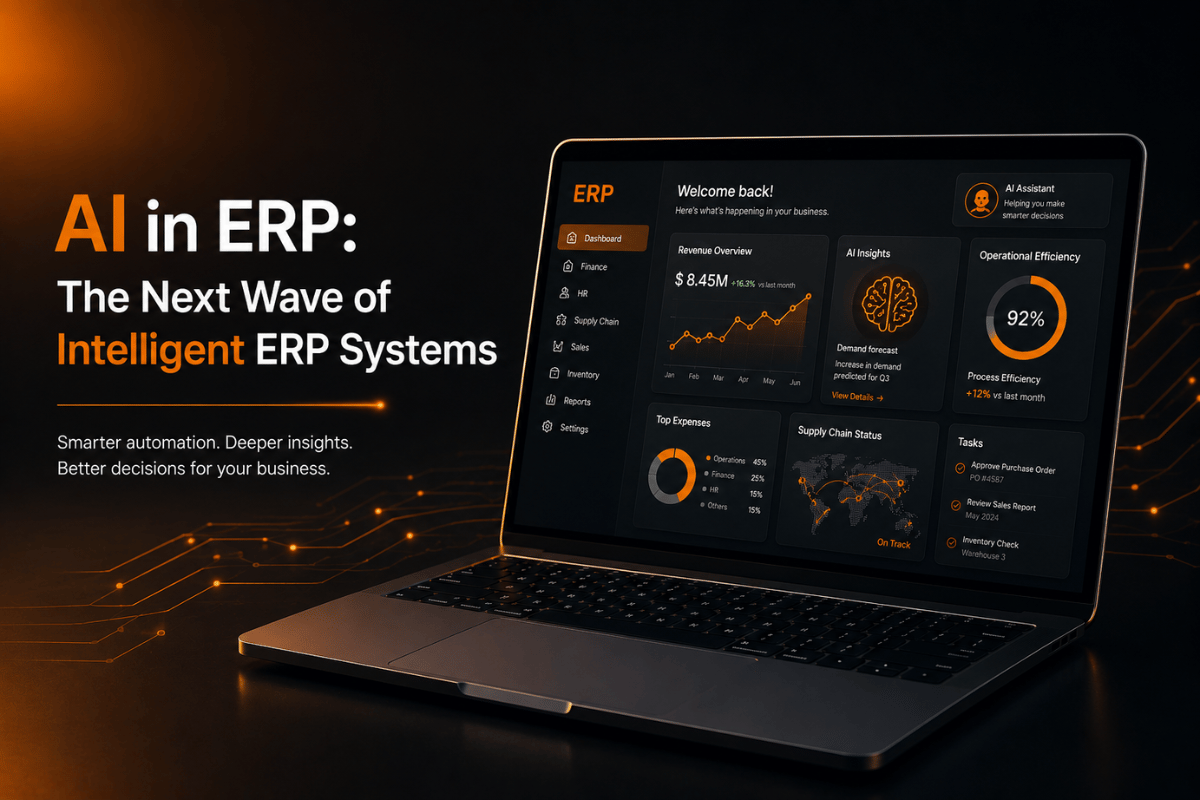
Artificial intelligence is introducing a new layer of intelligence that can help ERP platforms move beyond recording transactions toward identifying patterns, predicting outcomes, automating repetitive work, and supporting faster decisions.
This shift is creating a new generation of intelligent ERP systems in which business software does not simply tell organizations what happened. It can increasingly help them understand what is likely to happen next and what actions may be worth considering.
What Is an Intelligent ERP System?
An intelligent ERP system combines traditional enterprise resource planning capabilities with technologies such as artificial intelligence, machine learning, predictive analytics, natural language processing, and automation.
A conventional ERP might record a purchase order, update inventory, and store the transaction in a database.
An AI-powered ERP can do even more, like analyzing purchase behavior, detecting anomalous spending patterns, forecasting inventory needs, or predicting supply chain challenges.
It is not about eliminating the basic purpose of ERP. The purpose of AI is to make the data within an ERP more usable.
From Data Management to Predictions
Classic ERP systems are extremely efficient in structuring the business data. Yet, often people have to perform analysis of that data themselves before making any decisions.
AI can minimize this gap.
By analyzing the company’s sales history, inventory, supplier performance, seasonality, purchase activities, etc., a smart ERP could detect trends that would take hours for a person to uncover.
This transforms ERP from mainly being a transaction system into a proactive business intelligence solution.
How AI Transforms ERP Systems
Almost all the main components of an ERP can be influenced by AI technology.
Here are some of its applications within the financial management, manufacturing, supply chains, human resources, customer operations, and business forecasting areas.
AI in ERP Financial Management
Finance functions process huge volumes of transactional data. That makes the ERP financial management area especially beneficial for the application of AI technology.
With an AI-integrated ERP accounting system, an accountant will be able to detect exceptional transactions, classify expenses, automate reconciliation procedures, and spot any deviations that should undergo examination.
Instead of going through all transactions by hand, finance managers may concentrate on those that need human intervention.
Intelligent Financial Forecasting
AI technologies are capable of analyzing past financial data combined with present operational data to produce forecasts.
For instance, a business may leverage its intelligent ERP system to analyze the following factors:
·Trends in revenue generation
·Operating expenses
·Cash flows
·Customers' payment practices
·Obligations to suppliers
·Seasonality of operations
·Performance of the company based on historical financial data
All of these factors can contribute to better financial forecasting.
It is important to emphasize that AI cannot produce flawless predictions because they depend greatly on data quality, company performance, and models used.
AI and Supply Chain Management
A wide array of data is generated within a supply chain from the point of view of purchasing, logistics, warehousing, manufacturing, and distribution.
As such, ERP supply chain management functionality can serve as a perfect case for leveraging AI technologies.
ERP in Supply Chain Management
Imagine an enterprise where stock shortages occur regularly during some periods.
A regular ERP will show historical stock levels.
While an AI-enabled ERP will be able to analyze historical trends in demand and see that there is an increase in pressure on stock levels coming soon.
It is better for a purchasing department to take action before the actual shortage happens.
AI-Powered Manufacturing ERP
Modern manufacturing is becoming more and more data-driven. Production, machines, warehouses, suppliers, and quality assurance systems produce data that can be linked together using enterprise systems.
Current manufacturing ERP software allows you to have a common environment for managing all production processes, inventories, procurement, finance, etc.
The predictive power of AI can be added to such environments.
Predictive Maintenance
Equipment failure in production can stop your production line and cause serious costs.
AI algorithms will be able to analyze data produced by equipment and see patterns of future machine failure.
With the use of MES manufacturing execution system information, the ERP platform will have a wider view of production processes.
It does not mean that any failure will be predicted precisely. It means that you will be able to analyze and investigate potential problem areas.
Production Optimization
It is also possible for AI to analyze production schedules, resource availability, performance history, and information about demand.
As a consequence, it becomes easier to evaluate production scenarios and optimize them based on identified opportunities for improving efficiency.
The result of such an analysis is a closer connection between the organization's production ERP software, manufacturing operations, and business plans.
ERP and MES: What's the Difference?
There is a difference between how ERP and MES work within the context of manufacturing management.
ERP is responsible for managing general business operations, including finance, procurement, inventories, human resources, and planning.
MES manufacturing software concentrates on production-floor activities.
It can track production processes, equipment activities, work orders, quality information, and manufacturing performance.
Integration of these systems will provide better visibility to businesses regarding their operation.
After that, AI can analyze the data collected from these two environments to detect relationships between production activity and business results.
AI and CRM ERP Integration
ERP systems are not independent of other systems.
Apart from ERP and MES, businesses can have CRM platforms, websites, e-commerce systems, HR applications, analytics platforms, and various operational software.
CRM ERP integration can provide integration of customer information with financial, inventory, and operational information.
For instance, the sales team can view customer information in CRM and deal with invoices in ERP.AI can utilize this integration to spot patterns in customer activity, purchasing history, demand for products, and finance-related information.
AI in Human Resource Management
Human resources is yet another domain where ERP technology can develop with the help of AI.
Contemporary human resource management software can serve as a tool that centralizes information about employees, their attendance, payment, performance, and the structure of the organization.
AI could be used for:
·Workforce forecasting
·Analysis of employees' data
·Scheduling
·Recruitment
·Analysis of skills
·Analysis of employee engagement
·Automation of administrative procedures
However, HR applications have to be treated cautiously since the information about employees is very sensitive.
AI has to allow responsible decision-making instead of turning into an instrument of uncontrolled employment decision-making.
Cloud ERP and AI
Cloud computing has introduced changes into enterprise software deployment.
Such platforms as Oracle ERP Cloud and Oracle Fusion Cloud ERP demonstrate how ERP functions can be provided in the cloud.
Cloud ERP provides companies with centralized access, scalable infrastructure, automatic updates, and easier integration with other digital solutions.
AI would benefit from such an environment since intelligent applications usually require huge computing capacity and access to huge volumes of data.
Cloud-Based Integration
Contemporary businesses can connect ERP to the following systems:
·CRM systems
·Websites
·Mobile applications
·E-commerce platforms
·Payment gateways
·HR systems
·Analytics platforms
·Manufacturing systems
The higher the degree of connections in the architecture, the higher the degree of importance for secure and reliable ERP system integration becomes.
ERP for Small Businesses
ERP powered by AI is not reserved exclusively for large corporations.
Interest in ERP for small businesses is growing as companies try to find solutions to automate processes and become more transparent in terms of their operations.
Yet there are things small companies should take into account when selecting ERP software.
The best ERP for small business may not necessarily be the software with the biggest list of features.
What really matters is the following set of considerations:
·Real needs
·Complexity of implementation
·Users' adoption
·Integration needs
·Scalability
·Security
·Cost of ownership
·Support
A too-complicated ERP solution may lead to an excessive number of administrative actions instead of automation.
AI and Website Development
ERP systems are getting more integrated into a wider digital ecosystem nowadays.
The company's website may be connected to ERP systems to exchange data related to products, orders, customers, inventory, payments, and much more.
Website development becomes one of the key elements of modern ERP integration.
For instance, an e-commerce website may send a customer order to an ERP system and trigger further processes like inventory updates and order fulfillment.
Modern web technologies like Next.js may be used for building a fast, interactive interface communicating via API with backend systems.
The website will be a customer-facing layer, whereas the ERP system will still be an essential operational solution.
Intelligent ERP System in the Era of AI
Integrating AI into the ERP environment does not result in building an intelligent ERP business system.
An adequate ERP implementation process is still based on the basics of requirements, data quality, workflows, training, security, and proper architecture of the system.
Importance of Data Quality
The quality of the data used by AI systems plays a major role in the efficiency of their work.
If there is duplicated customer data, outdated information about products and stocks, inconsistent data, etc., the AI model may provide unreliable results.
This leads to an important conclusion:
The quality of business data affects the quality of AI.
User Acceptance Is Key
Employees should be able to understand how the AI-based functionality influences their processes.
In case of distrust or difficulties in working with the system, advanced technical ERP capabilities may become less valuable.
User training and change management become crucial aspects of the ERP implementation process.
Advantages of Intelligent ERP Systems
Properly implemented intelligent ERPs may have several significant benefits.
Fast Decisions
Employees may get needed insights automatically without analyzing a vast amount of data manually.
Less Manual Work
AI may automate many routine tasks like data classification, reconciliation, generating alerts and reports, etc.
Improved Predictions
Predictive models may show trends that help with demand, financial, inventory, and workforce planning.
Increased Visibility
Connecting different data within different departments allows managers to see a more comprehensive view of the company's performance.
Proactive Detection of Problems
AI can detect anomalies and even alert about problems before they turn into more serious operational issues.
Issues with Intelligent ERP Solutions
Despite the benefits, there are some downsides to intelligent ERP.
Data Security
ERP systems might hold all kinds of financial, HR, and customer data. It is vital to monitor access to this information.
Technical Complexity
Linking ERP with CRM, website, manufacturing systems, and other applications can take quite some technical planning.
High Cost
ERP deployments include not only licensing fees but also customization, migration, integration, training, and maintenance.
Thus, ERP price does not tell the whole story about costs that you need to consider when choosing one platform over another.
Automation Excess
Not all business decisions should be automated.
It is necessary to evaluate AI suggestions based on their significance and risks. In some cases, such as making financial, HR, and legal decisions, human intervention is vital.
The Future of Intelligent ERP
Future ERP will most probably evolve into being more and more conversational and proactive.
Instead of looking through a number of reports, people can just ask questions in natural language and get answers from interconnected business systems.
An executive could say:
What are the reasons behind the rise in operating costs during this quarter?
An intelligent ERP will be able to study the related financial and operational data and suggest possible causes.
In the same way, a supply chain management specialist could ask which products have the biggest chance of being in shortage due to the current demand and inventory situation.
The future of ERP is not just about making an existing system more intelligent through additional AI functionality. It is about building a business system that understands the context, correlates information, identifies patterns, and assists people in their decision-making.
# How Businesses Can Get Ready for AI-Enhanced ERP
Companies exploring the implementation of intelligent ERP should start from business needs, not technological trends.
A practical way forward would include:
1. Identifying repetitive and cumbersome processes.
2. Checking the quality of existing ERP data.
3. Mapping the existing systems and integrations.
4. Figuring out areas where AI can add tangible value.
5. Developing a data security and governance strategy.
6. Evaluating ERP platforms based on their real needs.
7. Beginning with simple cases.
8. Measuring performance before scaling up AI capabilities.
Such an approach can help companies avoid implementing AI just because it looks cool.
# Conclusion
Artificial intelligence changes the face of the ERP system, making it much more intelligent and able to deliver more predictive insights from the data.
When an executive asks a question like,
Why did operating costs go up in this quarter?
an intelligent ERP system would analyze all financial and operational data and show possible contributing reasons.
Also, a supply chain manager would want to know which products may have a shortage problem depending on current demand and inventory.
The future does not consist only of the fact that AI functionality will be added to the existing ERP software. The future of ERP lies in the creation of business systems that would be able to understand the context, integrate the information, see the patterns, and support decision-making.
# How Businesses Can Prepare for AI-driven ERP
Businesses interested in intelligent ERP solutions should start by solving their business problems instead of chasing technological trends.
Such an approach can include:
1. Identifying repetitive and time-consuming processes.
2. Analysis of the quality of ERP data.
3. Mapping current systems and integrations.
4. Figuring out where the application of AI could provide benefits.
5. Setting data security and governance policies.
6. Evaluating ERP solutions based on actual needs.
7. Starting with small use cases.
8. Measuring performance before scaling AI functions.
This approach allows avoiding the implementation of AI functionality just because it is fashionable.
From finance to manufacturing, supply chains, HR, retail, CRM integration, and website development, AI functionality can help businesses integrate information and automate processes.
However, an intelligent ERP system requires more than artificial intelligence. Such factors as data quality, integration, security, implementation approach, employee acceptance, and clear business goals are important.
If you are looking at modern ERP, custom software, and website development, or connected business systems, the QTO DEV team could be your partner in discussing the technologies needed for your operations.
Ready to talk about an intelligent ERP ecosystem for your business?