Job Description, Requirements, Responsibilities, and Career Progression
Machine learning is not restricted to laboratory and experimental purposes anymore. The use of smart algorithms can be seen in businesses when it comes to recommendations, prediction, automation, fraud detection, customer experience, decision-making, etc. However, the process of developing a machine learning model is just half the job done. And the rest is related to making the developed model dependable, scalable, safe, and useful in production environments.
That is why DevOpsgains its importance.
A Machine Learning DevOps Engineer combines the skills and expertise of software engineering, infrastructure, automation, cloud computing, and machine learning workflows for transitioning intelligent applications into dependable production environments. The position allows organizations to minimize friction in deployments, monitoring of systems, automation of repetitive tasks, and maintenance of machine learning applications.
What Does a Machine Learning DevOps Engineer Do?
A Machine Learning DevOps Engineer is a technologist who applies DevOps principles to machine learning systems.
Traditionally, software can be tested and deployed with the use of rather predictable code. In addition to this, machine learning introduces extra variables such as training datasets, model iterations, experiments, dependencies, inference performance, and evolving data patterns.
Given all of this, machine learning projects need more than conventional development operations.
A Machine Learning DevOps Engineer is supposed to take care of:
ØModel deployment automation
ØCloud infrastructure management
ØDevelopment of CI/CD pipelines
ØApplication and model performance monitoring
ØDevelopment environment management
ØMachine learning workflow facilitation
ØIncrease in system stability
ØSecurity measures implementation
ØCollaboration between development and operations teams
The goal is not only the deployment of a particular model. The goal is to develop a system that will allow updating of models and applications in a safe manner.
The Importance of DevOps in Machine Learning
The typical DevOps lifecycle gives guidelines for moving software from planning, development, testing, deployment, and monitoring. Similar steps are applicable to machine learning projects with some additional nuances.
One reason why a model works well during development but poorly in production is that the production data is different from the training data. It can also happen that a new version of the model behaves differently despite no changes in the application.
DevOps allows the implementation of automated testing, deployment, monitoring, and infrastructure management.
It means that DevOps automation is especially useful in companies having many machine learning models and regular releases.
Main Responsibilities of Machine Learning DevOps Engineers
Infrastructure Management
A Machine Learning DevOps Engineer can build and manage the infrastructure for running machine learning applications.
This can include computing capabilities, databases, containers, networking, storage, authentication services, clouds, etc.
An efficient DevOps infrastructure must be scalable and maintainable at the same time.
Automated infrastructure allows avoiding differences in configurations for development, testing, and production.
Creation of Automated Pipelines
One of the key ideas of DevOps is automation.
Machine Learning DevOps Engineer is able to create automated pipelines that will transfer code and models through the various phases of development.
The pipeline can be as follows:
ØCode validation
ØAutomated testing
ØModel validation
ØPackaging
ØDeployment
ØMonitoring
Using tools for continuous delivery and continuous deployment tools will help to minimize manual effort during the process of software and machine learning model release.
Continuous Testing in DevOps
When it comes to machine learning, testing becomes even more crucial.
In case of traditional software testing, the purpose is to check if the program complies with specific rules of work. Testing of machine learning systems may need some extra checks related to model accuracy, data quality, performance, etc.
Continuous testing in DevOps will help you to find potential problems early in the development process.
Automated testing can be done not only for the application but for all its components.
Monitoring and Observability
Deployment of an application does not mark the end of the journey.
The operation of a production machine learning system necessitates constant monitoring of technical and modeling issues. DevOps observability will provide visibility into application performance, infrastructure health, latencies, resource utilization, and many other factors.
Monitoring tools from the DevOps toolkit may assist the team in identifying issues before they become visible to the users.
In case of machine learning systems, monitoring can also include the tracking of model performance and changes in input data.
Key Competences of a Machine Learning DevOps Engineer
Cloud Computing
Contemporary machine learning applications are built around the need for flexible computing resources. The cloud allows an organization to build scalable infrastructure.
Knowledge of cloud computing application development and cloud infrastructure can be very useful for Machine Learning DevOps Engineers.
They can work with storage services, virtual machines, containers, managed databases, serverless computing, and any other cloud services.
Automation and CI/CD
A good understanding of CI and CD tools is critical.
Continuous integration allows developers to combine code and test it often, whereas continuous delivery or deployment helps to reliably deliver software to production.
Programming and Scripting
Programming skills may be required for Machine Learning DevOps Engineers in order to automate processes and connect various systems.
Python is one of them, as it is extensively used in machine learning and data science environments. Scripting and infrastructure automation will allow engineers to streamline their operational processes.
Security
Machine learning systems can work with sensitive information of businesses and their clients. Hence, the aspect of security should be taken into consideration through all the stages of development.
This has led to the emergence of DevSecOps, which incorporates security processes into development and operations instead of considering security as a separate process.
DevOps vs. DevSecOps
The main difference between DevOps and DevSecOps lies in the place of security in the development process.
While DevOps focuses on collaboration, automation, integration, deployment, and operations reliability, DevSecOps includes security aspects at all those stages.
In the case of machine learning systems, it means ensuring the safety of:
ØTraining data
ØAPIs
ØCloud environment
ØCredentials of applications
ØEndpoints of models
ØInformation of users
Organizations working with confidential data can take advantage of introducing security controls into automated development and deployment processes.
DevOps vs. SRE
Yet another comparison considered by contemporary engineering teams is site reliability engineer vs DevOps.
DevOps is usually a more general concept and approach centered around improving cooperation between development and operations with increased automation and efficiency.
SRE, or Site Reliability Engineering, focuses more on reliability, availability, performance, and measurable operational goals.
The two methodologies may have a lot of similarities.
The responsibilities of a Machine Learning DevOps Engineer include automating deployments through DevOps techniques and ensuring system reliability with the help of SRE principles.
Cloud Migration and Machine Learning
When migrating older applications or infrastructure to the cloud, an organization may need a cloud migration solution taking into account not only technological but also business requirements.
Workloads based on machine learning may have specific requirements in terms of computing power, specialized hardware, scalability, and fast data processing.
A properly organized cloud migration can increase flexibility, but migration shouldn’t just mean migrating infrastructure without proper architecture evaluation.
Evaluate the following when teams decide on cloud migration:
ØDependencies of applications
ØData storage
ØSecurity needs
ØCosts of infrastructure
ØScalability of solutions
ØPerformance of programs
ØDisaster recovery capabilities
For businesses with limited budgets, cloud migration can be beneficial because of providing access to infrastructure that would have been very expensive otherwise.
Development of Cloud Applications
Today, intelligent systems are developed as cloud applications, which are not independent software products anymore.
Cloud-based application development allows apps to utilize distributed infrastructure, remote services, APIs, databases, and computing power.
For instance, a business application can include such components as a web interface, mobile app, a machine learning algorithm, a CRM, an analysis system, and cloud infrastructure.
In this case, architecture becomes a crucial element.
Web Development and ML Solutions
ML algorithms do not work independently of other systems in a company's digital infrastructure.
It can be necessary to perform web development of a site that will serve as a user interface to work with an AI solution.
Thus, for example, a website may serve to connect a customer to a recommendation system, chatbot, prediction or search engine, personalization platform, etc.
CRM and Machine Learning
CRM systems can also leverage machine learning to gain an advantage.
A contemporary CRM system can leverage intelligent technology to analyze customer interactions, identify patterns, prioritize leads, personalize communication, and perform sales forecasting.
If CRM is combined with machine learning models, companies will be able to turn massive datasets of customer information into insights.
But the proper combination requires reliable APIs, security when working with data, adequate infrastructure, and the right processes.
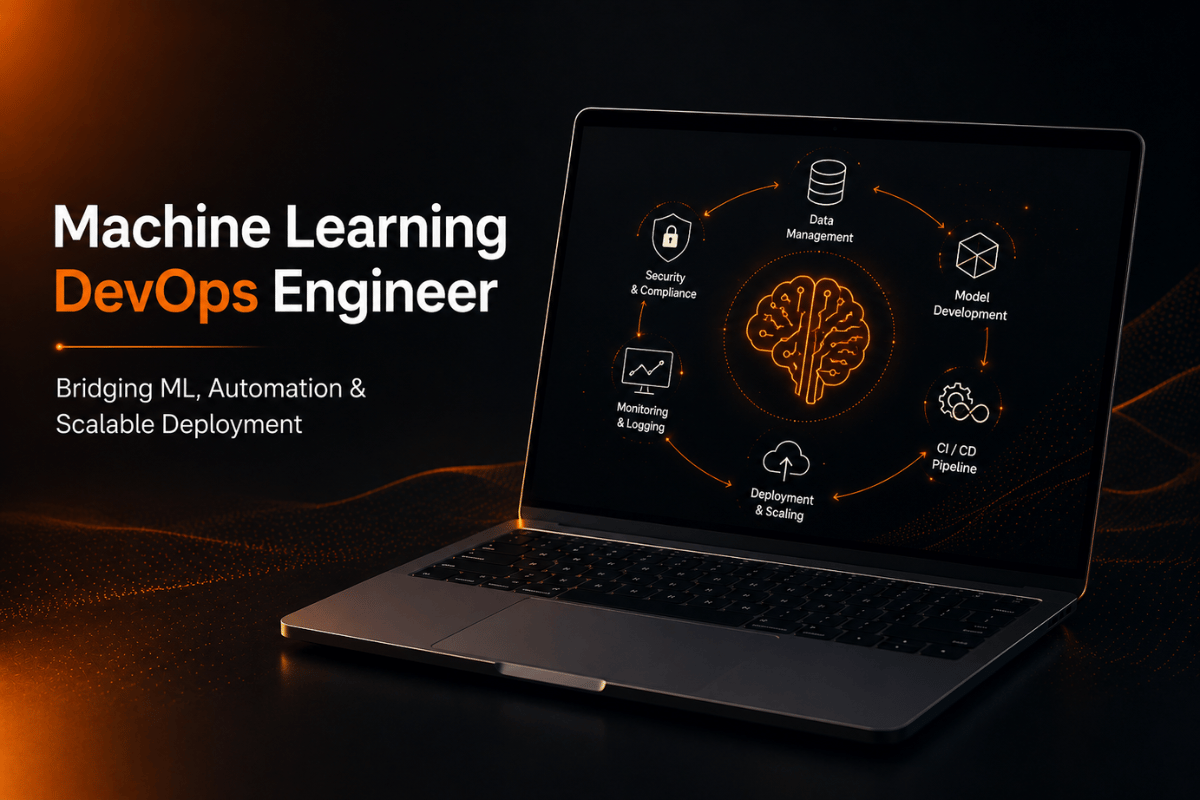
The Machine Learning DevOps Lifecycle
The machine learning lifecycle usually consists of several connected phases.
Planning
The business problem, technical requirements, data requirements, and the outcome are defined.
Development
Application development, data pipeline creation, and machine learning model creation are conducted by developers and data scientists.
Testing
Everything that was developed is tested before deployment into production.
Deployment
Deployment of validated components via automated deployment or other deployment processes.
Monitoring
Monitoring of production systems in order to detect issues with infrastructure, application failures, degraded performance, and other factors that might impact model quality.
Improvement
User feedback, monitoring data, and additional information can be used for improving future iterations.
This endless cycle is why contemporary DevOps is not only about deployment.
DevOps Transformation for Modern Businesses
When a company decides to use machine learning, it will find out that the technological transformation is not about model change alone.
A good DevOps transformation will include a series of steps, such as workflow redesign, infrastructure automation, improved cooperation, introduction of monitoring systems, and deployment standardization.
The idea behind such a transformation is to make sure that the technology environment allows the teams to implement changes without reducing security and reliability.
It is especially important when companies are going to link machine learning to websites, CRM, mobile apps, cloud technologies, and custom software.
How Businesses Can Prepare for Machine Learning DevOps
When a company is thinking about adopting machine learning,
it should start with its own needs.
A practical methodology involves:
1. Process identification of potential intelligent automation opportunities.
2. Current applications and infrastructure assessment.
3. Assessment of data sources and quality.
4. Security and compliance requirements definition.
5. Choice of adequate cloud and development architecture.
6. Implementation of CI/CD and testing practices.
7. Introduction of monitoring and observability practices.
8. Results measurement post-deployment.
A DevOps assessment will be useful for identifying possible flaws in current infrastructure and development practices prior to any major transformations taking place.
Conclusion
The position of a Machine Learning DevOps Engineer lies in the intersection of ML engineering, software development, cloud computing, automation, and operability.
As intelligent applications are becoming more frequent, just developing an efficient model is not sufficient anymore. Organizations require robust and reliable systems that would be capable of deploying models, monitoring them, securing sensitive data, and adapting to evolving needs.
From DevOps automation and CI/CD to cloud computing, observability, DevSecOps, website development, and CRM integration – modern technology environments are becoming more intertwined every day.
Firms that are keen on developing or upgrading their systems require a technological partner who is well-versed not only in the technology itself but also in the operations behind it. QTO DEV can assist firms in exploring new digital options when it comes to software, web, cloud, and intelligent technologies.
Want to make your technology needs a reality? Contact QTO DEV today.