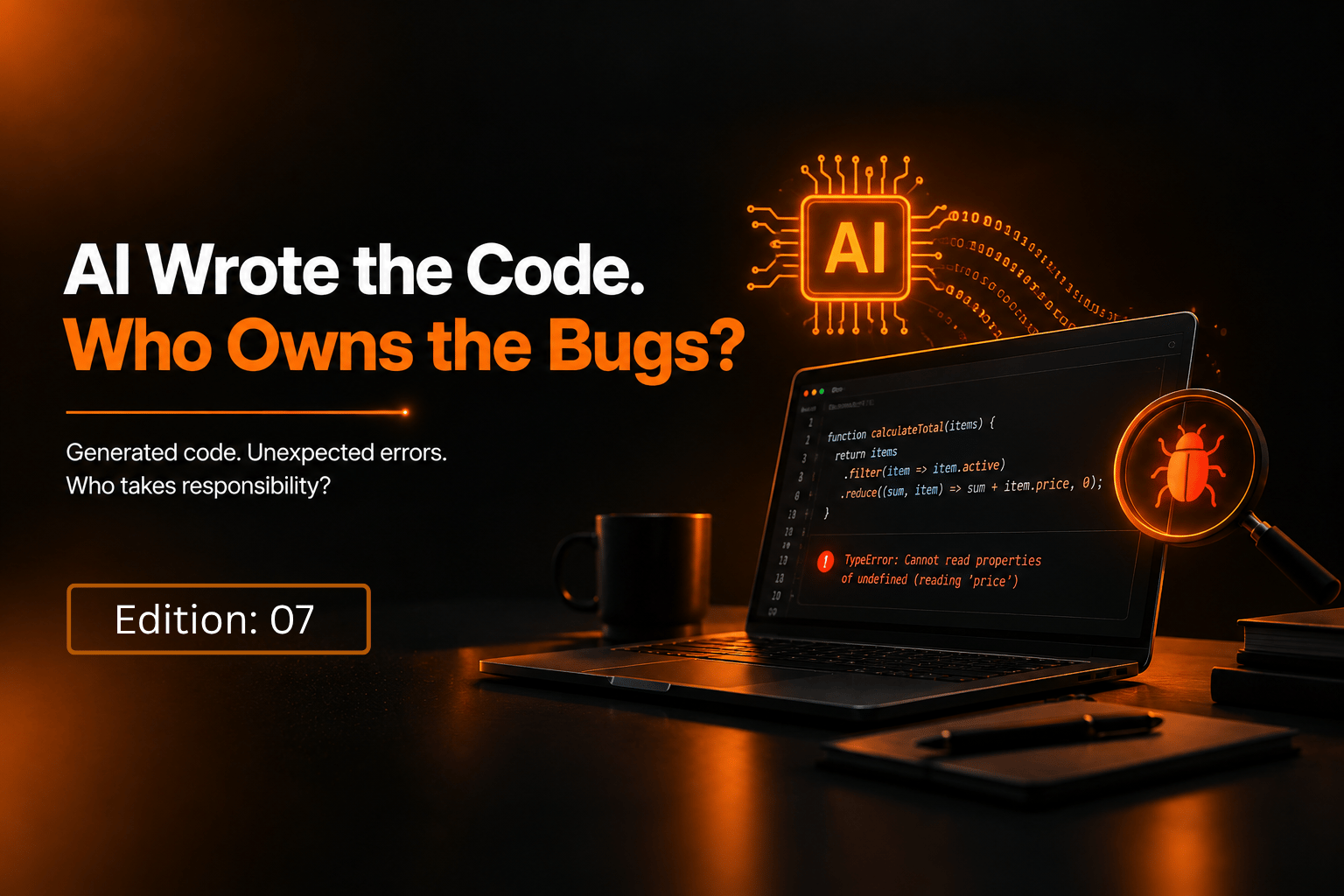
AI coding tools are changing how software gets built. They can draft functions, suggest fixes, generate tests, and help teams move through development tasks faster. But when AI-generated code causes a production bug, exposes data, or disrupts a service, one question matters more than who typed the code:
Who understood it, checked it, and decided it was safe to release?
That question is becoming increasingly important as AI contributes more to software development. A recent Economic Times report says AI generates 86% of new code at Paisabazaar. Yet the code still goes through developer review, automated testing, quality assurance, security checks, and user acceptance testing before release. The example shows that generating code and taking responsibility for it are different parts of the process.
Fast output still needs careful review
AI-generated code can look polished and work in a basic test. That does not guarantee it will behave correctly with unusual inputs, connect safely to other systems, or hold up under real customer traffic.
A piece of code may pass its initial checks and still rely on a faulty assumption. For example, it might handle a normal payment correctly but fail when a transaction is repeated, or work with sample data while exposing a weakness in how user permissions are managed.
The risk is not that every AI-generated change is faulty. The risk is assuming that a clean-looking answer or a successful test proves the code is ready. Tests are essential, but they only provide confidence in the situations they actually cover. Security checks, code review, and testing each catch different kinds of problems.
What does meaningful review look like?
Review should be more than a glance at a change or a box marked “approved.” Before code ships, a team should be able to explain what it does, why it is needed, and what could go wrong.
A practical review asks:
Does the code meet the original requirement?
Are the assumptions behind it clear?
Have relevant tests been run, including checks for edge cases?
Does the change affect authentication, payments, customer data, or another sensitive area?
Who approved it, and is there a plan to respond if it fails?
The Economic Times report notes that about 94% of surveyed developers in India use AI coding tools daily. It also reports that 92% of surveyed technology leaders raised concerns about deploying AI-generated code without human oversight, particularly around security and maintainability. Those figures point to an important tension: AI use is widespread, while leaders still see human review as necessary.
Assign ownership before release
When a bug appears, “the AI wrote it” does not help a team fix the issue or protect affected users. Someone needs clear responsibility for deciding whether a change is ready, monitoring its impact, and coordinating a response if it fails.
That does not mean one developer should carry every risk alone. Responsibility is shared across the software process: developers need to understand and review changes they accept; reviewers need enough context to assess them; and the organization needs a release process that defines who can approve and deploy code.
For higher-risk changes such as those involving access permissions, payments, personal information, or important integrations, teams should apply stricter review and testing. Security guidance for AI-generated code likewise emphasizes human review and automated checks before production use.
Build a safer AI-assisted workflow
Teams do not have to choose between using AI and maintaining quality. They can use AI as a development aid while keeping clear controls around the software they release.
A responsible workflow can include:
Define the requirements before asking AI for code. Clear instructions make it easier to judge whether the result is appropriate.
Ask a developer to understand the proposed change. The reviewer should be able to explain the logic, not just recognize familiar syntax.
Run tests and security checks. Use checks suited to the type and risk of the change.
Give sensitive changes extra scrutiny. Authentication, payments, customer records, and external integrations deserve careful review.
Keep a record of decisions. Document what was reviewed, who approved it, and how the team will respond if a problem appears after release.
The level of review can match the potential impact: a small text change and a change to payment processing do not need the same scrutiny. But every production change should have an owner and a way to verify its behavior.
The real measure of speed
AI may help teams produce code sooner, but speed only matters when the software works reliably for the people who depend on it. A faster release that creates avoidable bugs, security issues, or expensive rework is not necessarily progress.
The goal is not to remove AI from development. It is to use it without removing human understanding from the process. AI can contribute code; people and organizations still decide what to trust, test, and release.
At QTO Dev, we believe dependable software requires more than generating code. It takes clear requirements, thoughtful review, testing, security, and ownership throughout development. Building or improving a web application, ERP, or custom software product? Contact QTO Dev to discuss a development process that uses modern tools while keeping people accountable for what ships.